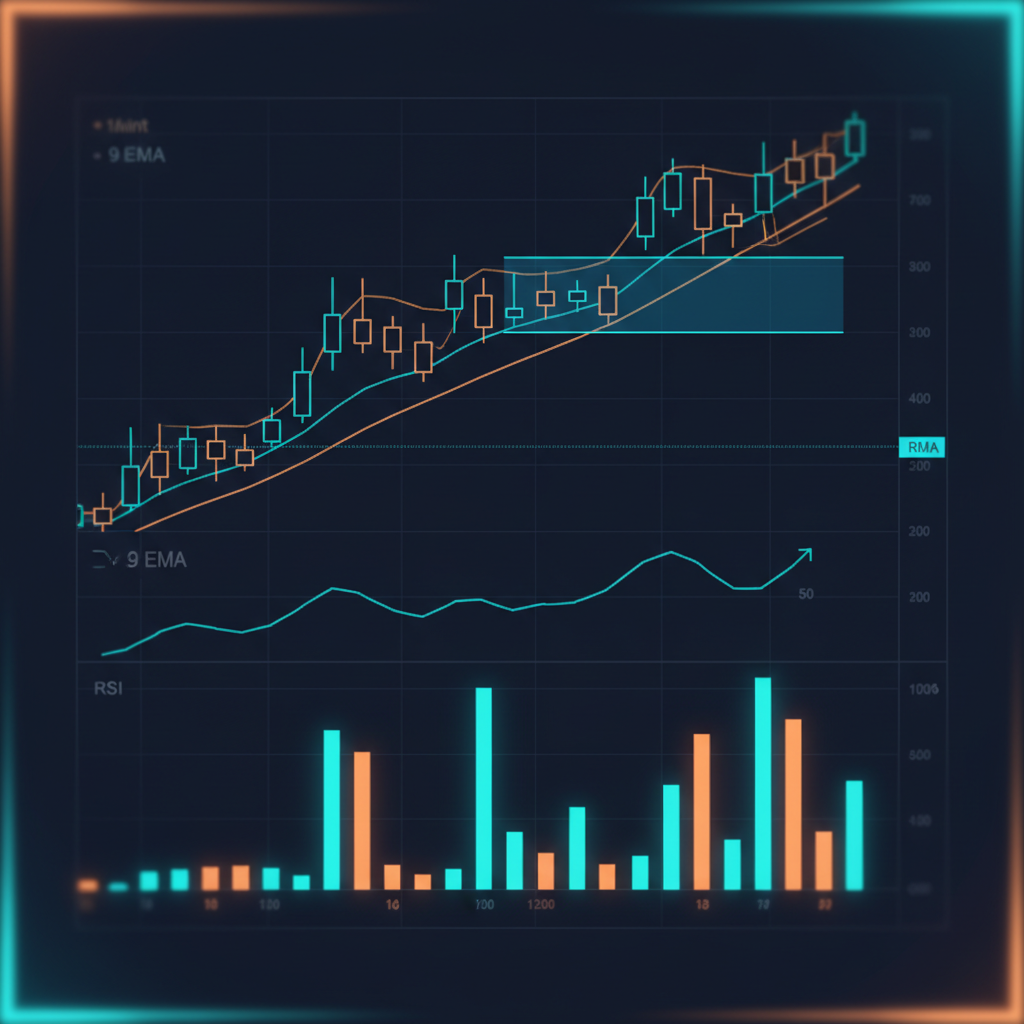

Scalping - Trading, The SQWAD Method
A disciplined, risk-first approach to crypto scalping - built on tight risk management, confluence, and emotional control. For educational purposes only.
NOTE⚠️ Educational Purposes Only - Not Financial Advice This guide is provided for educational and informational purposes only. Nothing here constitutes financial, investment, or trading advice. Crypto markets are extremely volatile and you can lose your entire capital. Always do your own research (DYOR) and never trade with money you cannot afford to lose. SQWAD and its contributors are not responsible for any losses.
Scalping is one of the most demanding styles of trading. It rewards discipline, speed, and emotional control - and punishes greed, hesitation, and revenge trading just as fast. The SQWAD Method is a structured framework built around risk-first thinking: protect capital first, find high-probability setups second, and let the math do the heavy lifting over many small trades.
This guide breaks down the method step by step.
Scalping is a short-term trading style where you aim to capture small price movements - often holding positions for seconds to minutes. Instead of waiting for a big move, a scalper stacks many small wins (and small losses) throughout a session.
- Day trading - holds for minutes to hours, targets larger intraday moves.
- Swing trading - holds for days to weeks, targets multi-day trends.
- Scalping - holds for seconds to minutes, targets micro-moves with high frequency.
The edge in scalping comes from repetition and consistency, not from any single trade. One trade means almost nothing - a hundred trades with a positive expectancy is where the method lives.
- Speed - decisions must be made in seconds.
- Fees - high trade frequency means fees compound fast.
- Emotion - rapid wins and losses test your discipline constantly.
- Focus - it requires sustained attention with no distractions.
NOTE✅ Pro tip - Scalping is not for everyone. If you tilt easily after a loss or struggle to follow a plan, scalping will amplify those weaknesses. Master a demo or paper-trading environment first.
The SQWAD Method is built on five pillars. Each one is non-negotiable.
Before you ever think about how much you can make, you define how much you can lose. Every trade has a predetermined stop loss set before entry. You never widen it to "give it room" - that is how small losses become big ones.
- Risk a fixed, small percentage of your account per trade (commonly 0.5% - 1%).
- The stop loss is placed at a logical invalidation point, not an arbitrary distance.
- If the setup does not give you a clean invalidation level, you skip the trade.
A single indicator is noise. The SQWAD Method requires multiple independent reasons to take a trade - this is confluence. A trade is only valid when at least 2-3 of the following align:
- Trend - trade in the direction of the higher timeframe trend.
- Level - a clear support/resistance, order block, or liquidity zone.
- Momentum - a momentum shift or confirmation candle.
- Volume - volume supporting the move (not a low-volume fakeout).
NOTE⚠️ Warning - Chasing a single candle or one indicator signal is gambling, not scalping. If you cannot point to at least two confluences, stand aside.
Every trade has a defined take-profit zone before entry. The SQWAD Method favours partial exits:
- Take a portion at the first logical target (lock in the win).
- Move the stop to break-even on the remainder.
- Let the runner trail toward the next level.
This converts a winning trade into a risk-free runner while banking gains early - critical for scalping psychology.
Scalping is mentally taxing. The SQWAD Method enforces a hard circuit breaker:
- 3 consecutive losses - stop trading for the session.
- 3 consecutive wins - reduce size or stop, to avoid overconfidence.
- Reaching your daily loss limit - close the platform.
The rule exists because the biggest damage in scalping is not one bad trade - it is the revenge spiral that follows it.
Every trade is logged: entry, exit, reason, confluences, emotion, and outcome. Over time the journal reveals your real edge - which setups work, which times of day suit you, and where your discipline breaks down.
NOTE✅ Tip - A journal is not a diary of wins. It is a diagnostic tool. The trades you skip are just as important to record as the ones you take.
The SQWAD Method uses a multi-timeframe approach:
- Higher timeframe (15m / 1H) - defines the trend and key levels.
- Execution timeframe (1m / 5m) - where you enter and manage trades.
You always know the higher timeframe direction before you look at the chart you trade on.
- Candlestick chart - clean, minimal clutter.
- Volume - essential for confirming moves.
- Key levels - manually marked support/resistance and liquidity zones.
- One momentum tool - e.g. RSI or MACD, used only for divergence/confirmation, never as a standalone trigger.
NOTE⚠️ Warning - More indicators do not mean more edge. A cluttered chart slows decisions. The SQWAD Method favours a clean chart with a few high-quality tools.
- A calm, distraction-free space.
- Reliable internet and a fast exchange/broker connection.
- No trading while tired, angry, or under the influence.
Run this checklist on every single trade. If any item fails, no trade.
| Step | Question | |------|----------| | 1 | Is the higher timeframe trend clear? | | 2 | Is price at a pre-marked key level? | | 3 | Is there a momentum confirmation? | | 4 | Does volume support the move? | | 5 | Is the stop loss at a logical invalidation? | | 6 | Is the risk within my fixed per-trade limit? | | 7 | Is the reward-to-risk at least 1.5:1? | | 8 | Am I calm and following the plan? |
If you cannot tick all eight, you stand aside. There is always another setup.
Risk management is the real edge in scalping. A strategy with a 40% win rate can be highly profitable if the winners are large enough and the losses are small.
Risk a fixed percentage per trade. Example with a 1% risk on a $1,000 account:
- Risk per trade = $10.
- If your stop is 1% away, your position size is calibrated so a 1% adverse move = $10 loss.
- The distance to your stop, not your opinion, sets your size.
The SQWAD Method targets a minimum 1.5:1 R:R. This means your potential reward is at least 1.5x your risk. With partial exits, your first target often banks 1R while the runner aims higher.
Set a hard daily loss limit (e.g. 2-3% of the account). Hit it and you are done for the day - no exceptions. This is the single most important rule for survival.
NOTE⚠️ Warning - Breaking your daily loss limit "just once" is how scalpers blow up accounts. The rule only works if it is non-negotiable.
The most reliable SQWAD entry is the pullback - price retraces to a key level in an established trend, shows a momentum shift, and resumes the trend. You enter on confirmation, not on hope.
Breakouts fail often. The SQWAD Method waits for confirmation - a retest of the broken level holding as support/resistance - rather than chasing the initial breakout candle.
- Stop loss - at the invalidation point, never moved against you.
- First target - bank a portion at the nearest logical level.
- Break-even - move the stop to entry on the runner.
- Trailing - let the runner trail toward the next level or a trailing stop.
NOTE✅ Pro tip - The exit is where most scalpers lose their edge. A great entry with a poor exit is a losing strategy. Practise exits as much as entries.
Scalping is 20% strategy and 80% psychology. The market will test your discipline on every trade.
- Revenge trading - trying to win back a loss immediately. The 3-strike rule kills this.
- FOMO - chasing a move already extended. If you missed the entry, you missed it.
- Hesitation - second-guessing a valid setup. Trust the checklist.
- Overconfidence - increasing size after a win streak. Size stays fixed.
- Tilt - emotional trading after a string of losses. Step away.
Think in batches of trades, not individual ones. A single loss is data, not failure. Your edge plays out over dozens or hundreds of trades. If you cannot stomach a losing streak - and every scalper has them - you will not survive long enough for the edge to show.
NOTE⚠️ Warning - If you ever feel the urge to "make it back today," close the platform. That urge is the account-killer speaking.
- No stop loss - the fastest way to lose everything.
- Moving the stop against you - turns small losses into disasters.
- Overtrading - taking low-quality setups out of boredom.
- Ignoring the higher timeframe - trading against the trend for no reason.
- Revenge trading - the 3-strike rule exists for this.
- No journal - flying blind with no way to improve.
- Trading news events blindly - extreme volatility and slippage.
- Increasing size after losses - a classic blow-up pattern.
The SQWAD Method in one loop:
- Check the higher timeframe trend and mark key levels.
- Wait for price to reach a level with confluence.
- Run the 8-point checklist.
- Enter with a fixed-risk position and a logical stop.
- Manage with partial exits and a break-even runner.
- Log the trade in your journal.
- Enforce the 3-strike rule and daily loss limit.
- Repeat - emotionless, mechanical, consistent.
The goal is not to be right on every trade. The goal is to survive long enough for your positive expectancy to compound across hundreds of trades.
NOTE⚠️ Educational Purposes Only - Not Financial Advice Nothing in this guide is a recommendation to buy, sell, or trade any asset. Scalping carries substantial risk and most participants lose money. Practise on a demo account first, never trade with money you cannot afford to lose, and seek advice from a qualified financial professional before making any investment decisions. SQWAD is an educational platform and is not responsible for any trading losses.
Found this guide helpful? Share it with others